
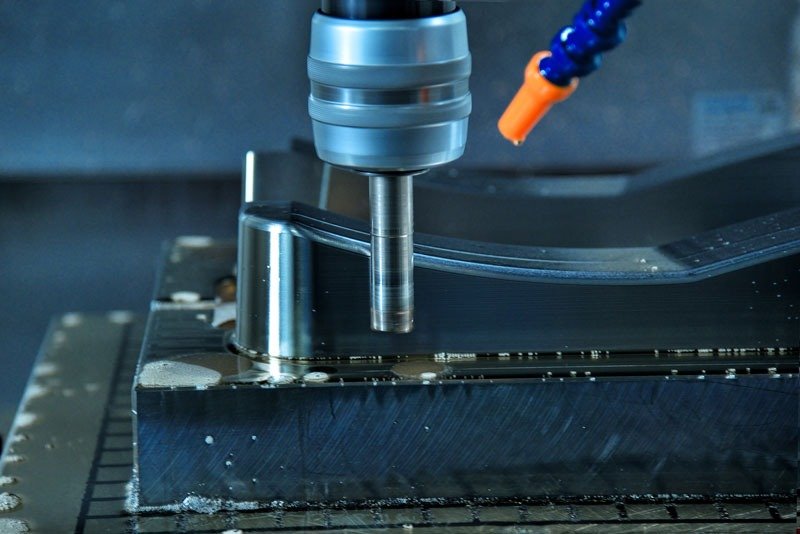
5-axis CNC machining is a subtractive process where the cutting tool can move along five axes — three linear (X, Y, Z) and two rotational. It runs in either 3+2 positional mode or full simultaneous mode, and its real value is being able to hit complex geometry in a single setup that a 3-axis machine simply can’t reach.
1. The Five Axes, Decoded
A 5-axis machine uses X, Y, Z linear motion plus two rotational axes, typically A and C, or A and B. ISO 841:2001 lays out the naming convention, which most people never actually read but should.
The Z-axis is always parallel to the principal spindle. That’s the anchor. X and Y follow the right-hand rule from there. Rotational axes get named for the linear axis they revolve around — A rotates around X, B around Y, C around Z.
Two rotational axes is enough to orient a tool at any compound angle within a hemisphere. Adding a third rotational axis buys you nothing geometrically and just introduces more mechanical compliance for the same envelope. This is why you don’t see 6-axis mills outside of very specific hybrid applications.
| Axis | Motion Type | Rotates Around | Typical Hardware Placement |
|---|---|---|---|
| X | Linear | N/A | Table left/right |
| Y | Linear | N/A | Table in/out |
| Z | Linear | N/A | Spindle up/down |
| A | Rotational | X-axis | Trunnion table tilt |
| B | Rotational | Y-axis | Swivel spindle head |
| C | Rotational | Z-axis | Platter rotation |
2. 3+2 Positional vs. Full Simultaneous 5-Axis
3+2 machining parks two rotational axes at a fixed angle and cuts using only X, Y, Z. Full simultaneous means all five axes are interpolating during the cut. That’s it. That’s the whole distinction, and most of the confusion in this space comes from people conflating the two.
Shops buy a 5-axis expecting to run simultaneous toolpaths on everything. Then the machine shows up and, anecdotally, most of what actually runs across the trunnion is 3+2. There’s no continuous rotational compensation to fight, the brakes lock the trunnion mechanically, and you can push a heavier chipload without the machine flinching. Simultaneous is for surfaces whose normal vector is constantly changing — impellers, blend surfaces on molds, the ugly stuff. If your part doesn’t need that, don’t program it that way.
| Feature | 3+2 Positional | Simultaneous 5-Axis |
|---|---|---|
| Axis Motion | A/B/C locked during cut, X/Y/Z move | All 5 axes interpolate |
| Primary Use Case | Angled holes, flats on multiple sides | Compound curves, impellers, implants |
| Programming | Standard 3-axis CAM with plane definitions | Premium 5-axis CAM modules required |
| Cycle Time | Slower (time lost indexing between faces) | Faster on complex sweeping surfaces |
3. Machine Kinematics — Trunnion, Swivel Head, Gantry
Three main configurations, and they aren’t interchangeable. Pick wrong and you’ll fight the machine forever.
Trunnion (Table/Table). Both rotary axes live under the workpiece. Great precision for small and medium parts. The trunnion itself sets your ceiling — the Haas UMC-500 uses a 15.7-inch diameter platter and tops out at 500 lbs (226.8 kg). Anyone speccing one of these needs to weigh the fixture plus the raw stock, not just the finished part.
Swivel Head (Head/Head). The spindle carries both rotary axes. Table stays put. This is what you want for heavy work — engine blocks, big mold cores, anything past a couple thousand pounds where you don’t want the machine trying to spin a steel block through space.
Gantry (Hybrid). Rotating head with a rotating table or a moving bridge. Aerospace structures, wing spars, panels several meters long.
Kinematic Decision Matrix
- Part under 500 lbs, fits in a 16-inch cube → trunnion (Haas UMC-500, DMG Mori DMU 50)
- Part over 1,500 lbs and bulky → swivel head
- 3-meter wing spar → gantry
4. RTCP — The Feature That Actually Makes 5-Axis Work
Rotation Tool Center Point (RTCP) is the control-side math that keeps the tool tip on its programmed path when the rotational axes move. You’ll also see it called TCPM or TCPC depending on the builder.
Without RTCP, the CAM software has to bake in the exact pivot length from the machine’s rotational center to the tip of the endmill. Swap a 2.0-inch tool for a 2.1-inch tool and the program is now wrong. Best case, the part scraps. Worst case, the tool tries to occupy the same space as the fixture.
With RTCP active, the controller handles the kinematics on the fly. CAM only has to output the tool tip coordinate and a vector. Fanuc turns this on with G43.4; Siemens uses TRAORI. If you’re evaluating an entry-level 5-axis machine, ask whether RTCP is standard or a $5,000 to $10,000 option, because on some builders it very much is.
5. What 5-Axis Can Make That 3-Axis Physically Cannot
Undercuts, negative draft, compound curves in one setup. Geometry a 3-axis simply cannot reach without breaking the part into multiple fixtures and eating the stack-up.
- Impellers and blisks. Flank milling (swarf cutting) rides the side of a tapered endmill against a twisted blade wall while A and C tilt to keep the tool parallel to the surface. One pass. A 3-axis has to step down the wall with a ball endmill and leaves scallops behind, which then get hand-blended, which then throws off the aero profile.
- Orthopedic implants. Cobalt-chrome knees and hips are continuous compound curves matched to bone geometry. Doing that across multiple fixture setups leaves blend marks you can feel with your thumbnail, and no surgeon wants that.
- Aerospace structural pockets. Weight reduction pushes designers into pocket geometries with negative draft — undercuts — to shave grams. A 5-axis spindle can reach under the ledge and clean the material out.
6. The Honest Cost Reality
Going from 3-axis to 5-axis is not a one-line capital request. It’s three separate buckets, and shops routinely underestimate two of them.
Machine. An entry-level trunnion like the Haas UMC-500 starts around $133,000 in 2026, and the Super-Speed variant (UMC-500SS) is roughly $185,995 before you add a pallet pool. A mid-range European or Japanese machine like a DMG Mori DMU 50 goes well over $250,000 depending on generation and options.
CAM. Your 3-axis CAM seat won’t post 5-axis vectors. Mastercam, Siemens NX, hyperMILL — full multiaxis modules plus verified post-processors run $10,000 to $25,000 per seat. Verified is the key word. Unverified posts are how spindles die.
Labor. This is the one people ignore. A general CNC operator sits around $52,900 median. A capable 5-axis programmer averages north of $107,000, and the good ones command more than that. If you can’t find one, you’re not really running a 5-axis shop, you’re running a very expensive 3+2 shop.
| Expense Category | Entry-Level 5-Axis | High-End 5-Axis |
|---|---|---|
| Capital Equipment | $130,000 – $190,000 | $300,000 – $800,000+ |
| CAM & Post-Processor | $10,000 – $15,000 | $20,000 – $35,000 |
| Programmer Base Salary | $85,000 – $95,000 | $105,000 – $130,000 |
| Resulting Shop Rate | $100 – $150 / hr | $175 – $300 / hr |
7. When 5-Axis Is the Wrong Choice
Every rotary joint you add is compliance you didn’t have before. A trunnion assembly has a tolerance stack that a properly built cast-iron 3-axis table just doesn’t have. For parts that live and die on dead-flat faces and bore straightness, a heavy 3-axis horizontal will still eat a trunnion machine’s lunch on rigidity.
Reddit’s r/Machinists is full of shops that moved 2D prismatic work onto an entry-level 5-axis and regretted it. Envelope shrinks. Fixtures crash into the spindle housing at tilt. And you’re paying $150/hr shop rate for what a $75/hr 3-axis would do without complaint.
Red flags:
- Geometry is strictly 2.5D prismatic
- Tight budget, no offline machine simulation software
- Tolerance requires absolute static rigidity
I’ll admit I still push clients toward 5-axis in borderline cases where 3-axis with a fourth-axis indexer would technically do the job. Partly it’s setup reduction, partly it’s habit. Not always defensible.
8. Programming and CAM — The Real Barrier
Shops don’t fail at 5-axis because the iron breaks. They fail because programming stalls out.
Simultaneous 5-axis toolpaths need real CAM — Mastercam, Fusion, hyperMILL, something with a proper multiaxis module. The danger is collision. On 3-axis, the spindle goes up and down. On 5-axis, the trunnion tilts the workpiece, the vise, and a chunk of the table casting toward the spindle housing all at once. This is where kinematic simulation earns its keep. VERICUT or equivalent, running the actual post output against a real machine model, before the door closes. Otherwise you’re rebuilding a $30,000 spindle.
A solid 3-axis programmer usually needs six to twelve months of dedicated 5-axis work before they can post simultaneous code without calling the reseller’s tech support every other day. Some never get there. That’s not a shot at them, some people are just wired for 2.5D work and there’s plenty of it.
9. Where 5-Axis Actually Dominates
- Aerospace. Single-setup on titanium structural brackets, minimizes stack-up. 16-station pallet pools running lights-out for 737 and A320 replacement work.
- Medical. Cobalt-chrome and titanium instruments and implants where the finish comes off the machine and doesn’t need hand polishing.
- Automotive. Prototype engine block modifications, deep mold cavities where short rigid tools have to reach without touching the walls.
- Energy. Swarf milling gas turbine housings and centrifugal impellers out of solid Inconel.
10. What to Ask When Quoting a 5-Axis Service
Not every shop calling itself “5-axis” is running the same hardware. A shop with a bolt-on 4th and 5th axis platter clamped to an old 3-axis is not the same shop as one with a purpose-built trunnion, and the tolerances they’ll actually hold won’t be either.
Buyer’s checklist:
- Kinematic type. Trunnion or swivel head? Part weight under table limits?
- Tolerance. Can they hold ±0.0005″ (0.013mm) across compound angles? Do they probe in-process to prove it?
- RTCP. Does the controller actually support active Tool Center Point management, or are they posting from CAM with a baked-in tool length?
- Certifications. AS9100D? ITAR? Certified aerospace work runs $175 to $300/hr and you should expect to pay it.
Obviously don’t send a shop an RFQ for Inconel work if they’ve only ever cut 6061.
FAQ
1. What is the difference between 3-axis, 4-axis, and 5-axis CNC?
3-axis moves the tool along X, Y, and Z. 4-axis adds one rotary (usually A), turning the part like a rotisserie. 5-axis adds a second rotational axis, letting the tool approach the workpiece from essentially any angle in a hemisphere.
2. Is 5-axis CNC machining more expensive than 3-axis?
Yes, and not by a small margin. Entry-level 5-axis machines run $130,000 to $190,000, with shop rates from $100 to $300/hr against $50 to $90/hr for standard 3-axis. The gap reflects capital, CAM, and labor, roughly in that order, though on smaller shops the labor line ends up being the one that actually hurts month over month because it’s the one you can’t amortize the same way you amortize a machine purchase, and it doesn’t go away when work slows down.
3. What is 3+2 axis machining?
Two rotational axes locked at a fixed angle, then cutting with X, Y, Z only.
4. What materials can be machined on a 5-axis CNC?
Aluminum, steel, titanium, Inconel, cobalt-chrome, engineering plastics, wood. Material sets the required spindle torque and machine rigidity — an entry-level trunnion that cuts aluminum all day will complain the moment you put titanium on it.
5. How accurate is 5-axis CNC machining?
A quality machine with thermal compensation, linear scales, and in-process probing can hold ±0.0005 inches (0.013mm) across multiple faces. Ballpark. Actual results depend on setup, fixture stiffness, and how honest the shop is being about their acceptance criteria.